

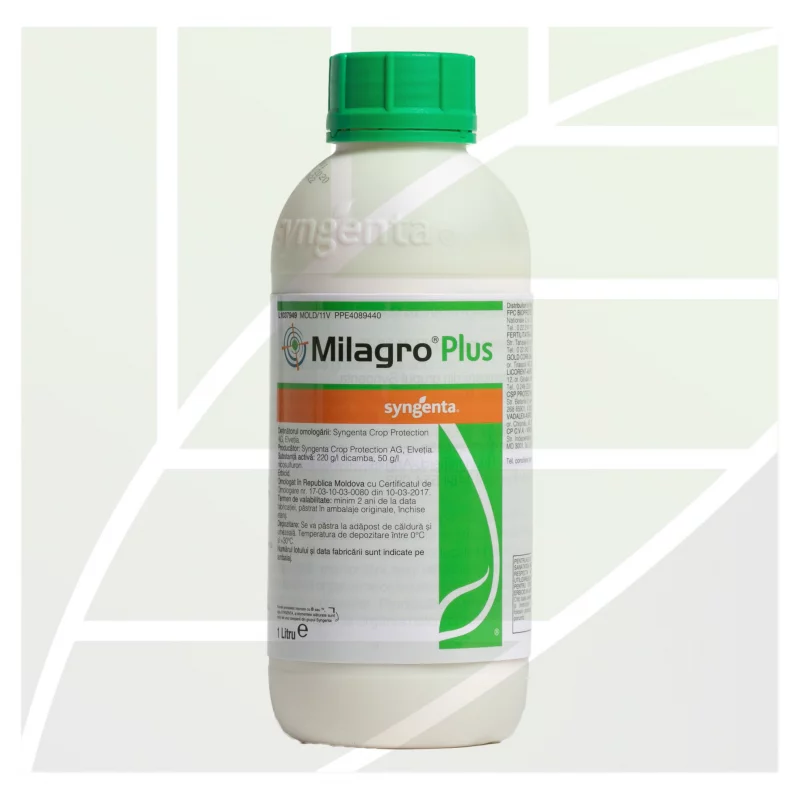
MILAGRO PLUS
- Category: Plant protection products
- Producer: Syngenta
Product Description
Milagro® Plus
Product Description
Herbicide for controlling the most difficult weeds in maize crops.
Works due to the synergy of two active ingredients: nicosulfuron and dicamba, in an oil dispersion (OD) formulation.
Maximum recommended dose: 1.2 L/ha, effective against a wide spectrum of annual and perennial mono- and dicotyledonous weeds.
Mode of Action
Nicosulfuron: controls annual and perennial monocot weeds; rapidly absorbed through leaves and translocated via xylem and phloem to meristematic tissues, inhibiting growth, causing chlorosis, necrosis, and plant death. Inhibits ALS enzyme, stopping cell division.
Dicamba: controls annual and perennial dicot weeds (including Convolvulus arvensis and Cirsium arvense); acts via an auxinic mechanism, blocking growth by binding to growth protein receptors, causing defoliation, tissue destruction, and root necrosis.
Application Recommendations
Perennial weeds: use maximum dose 1.2 L/ha.
Do not use for seed production or sweet corn.
Optimal stage: from 2 leaves (BBCH 12) to 6 leaves (BBCH 16).
Corn for grain or forage can be reseeded immediately after crop destruction, following deep plowing.
Winter cereals and rapeseed can be sown in autumn; sugar beet, sorghum, and sunflower the following spring (1 year after application), after plowing.
Technical Parameters
| Crop | Control Spectrum | Rate L/ha | Working Volume L water/ha | Application Stage | Waiting Period (Max Treatments) |
|---|---|---|---|---|---|
| Maize | Annual and perennial mono- and dicot weeds | 0.8 – 1.2 | 200 – 300 | Spray seedlings at 2–6 leaf stage | - (1 treatment) |
Active Ingredients and Registration
Dicamba 220 g/L, Nicosulfuron 50 g/L
Formulation: Oil dispersible (OD)
Registration number: 17-03-10-03-0080


